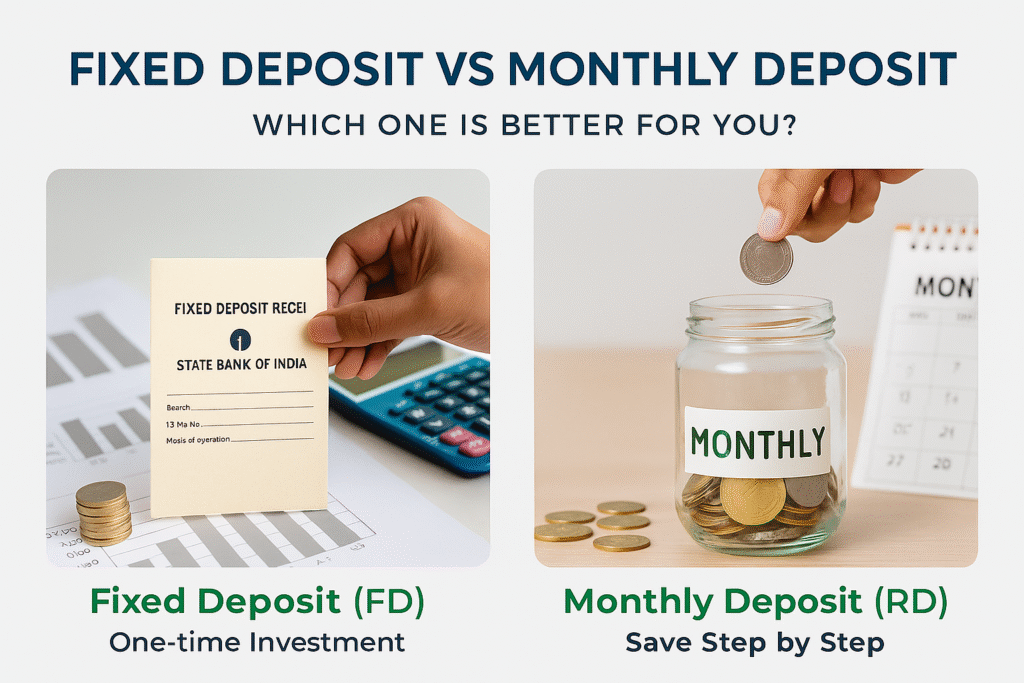
When it comes to saving money safely, most Indians think of bank deposits — either a Fixed Deposit (FD) or a Monthly Deposit (RD). Both are low-risk and offer guaranteed returns, but they serve slightly different financial goals.
So, which one should you choose — FD or RD? Let’s break it down in simple terms.
1. What Is a Fixed Deposit (FD)?
A Fixed Deposit is a lump-sum investment.
You deposit a certain amount — say ₹50,000 or ₹1 lakh — at once, and the bank pays you a fixed interest for a chosen period (like 6 months, 1 year, or 5 years).
At the end of the term, you get your principal + interest back.
✅ Example:
You invest ₹1,00,000 for 1 year at 7% interest → You get ₹1,07,000 at maturity.
Best for:
- People who have a lump sum amount to invest.
- Short- or medium-term goals like vacations, weddings, or emergency funds.
2. What Is a Monthly Deposit (RD)?
A Monthly Deposit, also called a Recurring Deposit (RD), lets you invest a fixed amount every month.
It’s ideal if you can’t deposit a big sum at once but want to build savings gradually.
✅ Example:
You invest ₹2,000 every month for 2 years at 7% interest → You get around ₹52,000 at maturity.
Best for:
- Salaried individuals or students.
- People looking to develop a savings habit.
- Future goals like buying a gadget or funding a small business.
3. Key Differences Between FD and RD
| Feature | Fixed Deposit (FD) | Monthly Deposit (RD) |
|---|---|---|
| Investment Type | One-time lump sum | Monthly contributions |
| Interest Rate | Slightly higher | Slightly lower |
| Flexibility | Less flexible (lock-in) | More flexible (small monthly deposits) |
| Ideal For | People with surplus cash | Regular savers with monthly income |
| Returns | Earns interest on full amount from day one | Interest builds up gradually |
| Discipline | Needs one-time decision | Builds monthly savings habit |
4. Which One Should You Choose?
Your choice depends on your financial situation and goals:
- 💼 Choose FD if:
- You have a large amount ready to invest.
- You want higher and faster returns.
- You’re saving for a fixed-term goal (1–3 years).
- 🧾 Choose RD if:
- You want to save bit by bit every month.
- You’re just starting your savings journey.
- You prefer a low-commitment way to grow money.
5. Pro Tip — Combine Both for Best Results
You don’t have to choose only one.
Start a Recurring Deposit to build your habit, and whenever you accumulate a good amount, convert it into a Fixed Deposit for higher returns.
This combination helps you stay consistent and earn better interest.
Final Thoughts
Both FD and RD are safe, reliable, and perfect for disciplined savers.
If you have money ready — go for an FD.
If you want to save gradually — start an RD.
No matter which one you choose, what matters most is starting today — because every rupee you save now brings you closer to financial freedom tomorrow.
“Savings are not about how much you earn, but how wisely you plan.”